DHA Nursing Exam vs Saudi Prometric: What’s the Difference?

Choosing between the DHA Nursing Exam and the Saudi Nursing Licensure Examination (SNLE), often referred to as the Saudi Prometric exam, can be confusing for nurses planning to build a career in the Gulf. Both are part of professional licensing pathways, but they differ in eligibility, exam structure, licensing authority, and application procedures.  In this blog, Concise International, one of the leading nursing job agencies in Kerala, discusses the key differences between the DHA Nursing Exam and the Saudi Prometric exam. Understanding the differences between these two pathways can help nurses make an informed decision and choose the right licensing pathway for their international nursing career. DHA Nursing Exam vs Saudi Prometric For nurses planning to build an international career in the Gulf, understanding the correct licensing pathway is an important first step. Two commonly discussed options are the DHA Nursing Exam for nurses planning to work in Dubai and the Saudi Nursing Licensure Examination (SNLE) pathway for nurses seeking professional classification and registration in Saudi Arabia.  While both pathways assess a nurse’s professional knowledge and competency, the application process and requirements are not the same. The DHA pathway is intended for nurses who wish to work in Dubai, UAE, whereas the Saudi Nursing Licensure Examination (SNLE) is relevant to nurses seeking professional classification and registration in Saudi Arabia. Knowing which authority, examination format, and verification process applies to your preferred destination can help you avoid confusion and plan your licensing journey more effectively.  Although both pathways involve computer-based nursing examinations and professional credential verification, they are governed by different healthcare authorities and have different application and professional registration or licensing procedures. DHA Nursing Exam vs Saudi Prometric: What’s the Difference? The primary difference between the DHA Nursing Exam and the Saudi Nursing Licensure Examination (SNLE), commonly referred to as the Saudi Prometric exam, is the country and regulatory authority under which a nurse intends to practise. The DHA pathway is applicable to nurses who want to work in Dubai, UAE, while the Saudi Nursing Licensure Examination (SNLE) is part of the professional classification and registration pathway for nurses planning to work in Saudi Arabia.  Both pathways may involve Prometric as the examination delivery provider, but Prometric itself is not the licensing authority. The relevant healthcare regulator determines eligibility, professional requirements, examination standards, and professional registration or classification requirements. Work Location The DHA Nursing Exam is associated with professional licensing in Dubai, United Arab Emirates. Nurses who intend to work in Dubai must meet the applicable requirements established by the Dubai Health Authority and complete the required assessment, registration, and licensing procedures.  The Saudi Nursing Licensure Examination (SNLE) is part of the professional classification and registration pathway in Saudi Arabia. Nurses seeking employment in Saudi Arabia generally need to follow the applicable requirements of the Saudi Commission for Health Specialties (SCFHS).  Therefore, your intended destination should be the first consideration when selecting a licensing pathway. Planning to work in Dubai? Follow the applicable DHA pathway. Planning to work in Saudi Arabia? Follow the applicable SCFHS/SNLE pathway. Licensing Authority The licensing authority is another important difference between the two pathways. For Dubai, the Dubai Health Authority (DHA) is responsible for healthcare professional registration and licensing, as well as related assessment procedures. Applicants use the DHA’s professional licensing system, including Sheryan, where applicable.  For Saudi Arabia, the Saudi Commission for Health Specialties (SCFHS) is responsible for professional classification and registration. Relevant professional services are managed through the Mumaris+ system.  It is important not to confuse the regulatory authority with the examination provider. Prometric is a testing provider, while DHA and SCFHS establish and administer their respective professional regulatory processes. Data Flow Verification Order Document verification is an important part of overseas nursing licensing and is separate from the examination. For the DHA pathway, applicants are required to complete Primary Source Verification (PSV) through DataFlow as part of the professional licensing process. This process is used to verify professional qualifications and other credentials directly with their original sources. For the Saudi pathway, SCFHS also requires verification of relevant educational and professional credentials according to its applicable procedures. Exam Format The DHA nursing assessment for Registered Nurses is conducted through computer-based testing. According to DHA’s published assessment guideline, candidates are required to answer 150 multiple-choice questions within a three-hour examination appointment.  The questions assess nursing knowledge and competencies relevant to the professional role. Candidates preparing for the DHA pathway should refer to the latest official assessment information and applicable examination guidelines before beginning their preparation.  The Saudi Nursing Licensure Examination (SNLE) is also delivered as a computer-based examination through an approved testing provider.  The current SNLE structure consists of 200 multiple-choice questions divided into two sections of 100 questions each. Each section is allocated 120 minutes, with a scheduled 30-minute break between the sections.  Because examination structures and requirements can be updated, candidates should verify the latest SNLE examination guidelines before preparing for the test. Which Exam Should You Choose? The answer depends primarily on where you want to build your nursing career. Choose the DHA pathway if: You plan to work as a nurse in Dubai. Your preferred destination is the UAE, specifically Dubai. You are prepared to meet DHA’s professional registration and licensing requirements. Choose the Saudi SNLE/SCFHS pathway if: You plan to work as a nurse in Saudi Arabia. You need to complete the applicable SCFHS professional classification process. You are prepared to meet Saudi Arabia’s professional and credential requirements. Before selecting a pathway, consider your preferred destination, eligibility, professional experience, educational qualifications, documentation, and long-term career goals Conclusion The comparison between the DHA Nursing Exam and Saudi Prometric becomes clearer once the destination and regulatory authority are identified. The DHA pathway is relevant to nurses seeking professional licensing to work in Dubai, UAE, while the Saudi SNLE/SCFHS pathway is relevant to nurses pursuing professional classification and registration in Saudi Arabia. Although both pathways can involve computer-based examinations delivered through Prometric, they differ in their regulatory authorities, verification procedures, examination


BSc Nursing vs GNM

Choosing between BSc Nursing and GNM (General Nursing and Midwifery) is a common concern among aspiring nursing professionals, especially those planning to build a career in the GCC countries. With differences in course duration, qualifications, career opportunities, and eligibility requirements, understanding which pathway aligns with their professional goals can be challenging. In this blog, Concise International, a trusted nursing job agency in Kerala, explores the key differences between GNM and BSc Nursing in the context of the GCC job market. Understanding these differences can help aspiring nurses make informed decisions based on their career aspirations, educational preferences, and long-term professional goals. BSc Nursing vs GNM: Which Qualification Gives Indian Nurses Better GCC Opportunities? For Indian nurses aspiring to work in the Gulf Cooperation Council (GCC) countries, both BSc Nursing and General Nursing and Midwifery (GNM) can offer pathways to international employment. However, the qualifications may differ in terms of job eligibility, professional classification, career progression, and opportunities for further education. BSc Nursing generally offers broader long-term career opportunities in the GCC, particularly for nurses targeting staff nurse positions, career advancement, and further professional education. GNM-qualified nurses may also find employment opportunities, but their eligibility can be more dependent on the destination country’s licensing requirements, clinical experience, and the employer’s criteria. The GCC includes Saudi Arabia, the United Arab Emirates (UAE), Qatar, Oman, Kuwait, and Bahrain. Each country has its own nursing registration and licensing framework, and qualification recognition is not automatically transferable between them. Therefore, aspiring nurses should consider both their educational qualification and the specific requirements of their preferred destination before making a career decision. BSc Nursing vs GNM- Key Differences in the GCC Market Although BSc Nursing and GNM graduates may both pursue nursing careers in the GCC, their qualifications can influence the roles they are eligible for, their career progression, and the professional opportunities available to them. Understanding these differences can help aspiring nurses plan their international careers more effectively. Job Level and Professional Classification  One of the most important differences between BSc Nursing and GNM in the GCC market is the professional category under which a nurse may be licensed. The classification depends on the relevant country’s regulatory framework, the qualification obtained, and the applicant’s professional credentials. BSc Nursing: A Bachelor of Science in Nursing is a degree-level qualification that can support eligibility for Registered Nurse or equivalent professional classifications, subject to the destination country’s licensing criteria. GNM: GNM is a nursing diploma. Depending on the country and the applicable licensing requirements, GNM graduates may be considered for nursing technician, assistant nurse, or other eligible nursing categories. A GNM qualification does not automatically guarantee Registered Nurse classification across the GCC. For example, Saudi Arabia’s Saudi Commission for Health Specialities (SCFHS) distinguishes between Nurse/Midwife Specialist, which requires a bachelor’s degree in nursing or an equivalent qualification, and Nurse/Midwife Technician, which includes qualifying diploma holders. In the UAE, the Unified Healthcare Professional Qualification Requirements (PQR) distinguish Registered Nurse and Assistant Nurse categories based on qualification and other eligibility criteria. Therefore, BSc Nursing may provide a more direct route to degree-level nursing classifications, while GNM graduates should verify the exact professional title available to them before applying for GCC positions. Salary and Career Growth  Salary differences between BSc Nursing and GNM graduates in the GCC are not determined by the qualification alone. Employers may consider professional classification, clinical experience, specialty, healthcare facility, job responsibilities, and the overall employment package. BSc Nursing graduates may have access to a wider range of Registered Nurse positions and, with relevant experience and further qualifications, may pursue senior clinical, supervisory, or specialist roles. GNM graduates may also progress professionally, but their opportunities can be influenced by the nursing category under which they are licensed and the employer’s promotion criteria. It is important to understand that a BSc Nursing qualification does not guarantee a higher salary, and a GNM qualification does not automatically mean lower earnings. Actual compensation varies across GCC countries, healthcare facilities, and individual employment contracts. Aspiring nurses should compare salary, accommodation, transport, insurance, overtime, and other benefits rather than relying on a qualification-based salary estimate alone. Licensing Exams and Eligibility  Nursing professionals planning to work in the GCC must meet the licensing and registration requirements of their intended destination. These may include qualification assessment, primary source verification, professional registration, clinical experience, and a licensing examination, where applicable. GCC destination Regulatory authority UAE DHA, DOH, MOHAP, or the relevant authority Saudi Arabia Saudi Commission for Health Specialities (SCFHS) Qatar Department of Healthcare Professions (DHP) Oman Ministry of Health (MOH) Kuwait Ministry of Health (MOH) Bahrain National Health Regulatory Authority (NHRA) In the UAE, the licensing process may involve primary source verification through DataFlow and a computer-based assessment through Prometric, if required. The Dubai Health Authority (DHA) also provides a self-assessment tool to help applicants review their eligibility under the PQR In Saudi Arabia, SCFHS determines a healthcare practitioner’s professional classification based on qualifications, experience, and the required assessment. For both BSc Nursing and GNM graduates, meeting the educational requirements alone does not guarantee a licence. Candidates should verify the current requirements for their specific qualification, professional category, and destination country before beginning the licensing process. BSc Nursing vs GNM-Course Overview Before choosing between BSc Nursing and GNM for a career in the GCC, aspiring nurses should understand the educational structure, duration, and professional training associated with each course. Both programmes prepare students for nursing practice, but they differ in academic level, curriculum, and opportunities for further education. BSc Nursing (Bachelor of Science in Nursing) BSc Nursing is an undergraduate degree programme that generally takes four years to complete in India. It combines theoretical nursing education, clinical practice, and practical training across different areas of healthcare. The curriculum typically includes anatomy, physiology, microbiology, pharmacology, medical-surgical nursing, community health nursing, and other nursing specialities. The degree can also provide a foundation for postgraduate nursing education, subject to admission requirements. GNM (General Nursing and Midwifery) GNM is a diploma-level nursing programme that traditionally takes three

Hospital vs Clinic Jobs in GCC?

For Indian nurses planning to work in the Gulf Cooperation Council (GCC) countries, choosing between a hospital and a clinic can have a significant impact on career growth, working conditions, and lifestyle. In this blog, Concise International, a Kerala nurse recruitment agency, explores the key differences between hospital and clinic nursing jobs in the GCC, including work environments, benefits, career growth, and hiring opportunities. Understanding these differences can help Indian nurses make a more informed decision based on their experience, career goals, and preferred lifestyle. Hospital vs Clinic Jobs in GCC: Which Is Better for Indian Nurses? There is no one-size-fits-all answer to whether hospital or clinic jobs are better for Indian nurses in the GCC. Both offer different work environments, responsibilities, career opportunities, and work schedules. The right choice depends on your career goals, experience level, clinical interests, preferred work environment, and lifestyle. Understanding these differences can help you choose a role that aligns with your professional plans and personal priorities. Hospital Jobs Work Environment Hospital nursing generally involves a fast-paced and clinically diverse work environment. Nurses may work in departments such as Emergency, Intensive Care Units (ICUs), Operating Theatres, Medical-Surgical Units, Paediatrics, Obstetrics and Gynaecology, Cardiology, and other specialised departments. Hospital nurses often care for patients with acute or complex medical conditions. Their responsibilities may include patient assessment, continuous monitoring, medication administration, clinical documentation, coordination with multidisciplinary teams, and emergency care when required. Shift-based work is common in hospitals. Depending on the department and employer, nurses may work day, evening, night, weekend, and public-holiday shifts. Benefits & Perks Hospital positions can provide exposure to a wide range of clinical cases and specialised departments. Depending on the employer, country, and employment contract, nurses may receive benefits such as accommodation or a housing allowance, transportation or a transportation allowance, health insurance, annual leave, air-ticket benefits, and end-of-service benefits. However, benefits vary between employers, countries, and employment contracts. Nurses should always review the complete employment contract before accepting a position. Career Growth Hospitals generally provide greater exposure to specialised and acute-care nursing. This can be valuable for nurses who want to develop expertise in areas such as critical care, emergency nursing, perioperative nursing, oncology, cardiology, or other specialities. Large hospitals and healthcare networks may also provide opportunities for continuing education, professional development, clinical training, and progression into senior nursing and leadership roles. Hospital experience can strengthen a nurse’s professional profile when applying for specialised positions or pursuing further career advancement within the healthcare sector. Hiring Demand Hospitals are major employers of nurses across the GCC because they provide inpatient, emergency, surgical, critical-care, and specialised healthcare services. For Indian nurses with relevant qualifications, clinical experience, and the required professional licensing or registration, hospital positions can offer a range of employment opportunities. Clinic Jobs Work Environment Clinic nursing generally takes place in outpatient, primary-care, speciality-care, or ambulatory healthcare settings. Compared with many hospital roles, clinic nurses often work with scheduled patients and may have fewer patients requiring continuous monitoring. Depending on the type of clinic, responsibilities can include patient assessment, monitoring vital signs, medication administration, wound care, health education, vaccination services, assisting physicians during consultations, maintaining patient records, and coordinating follow-up care. Working hours can be more predictable in some clinics, although this depends on the facility and its operating schedule. Some clinics may operate extended hours, on weekends, or provide urgent-care services. Benefits & Perks Clinic jobs can be suitable for nurses who prefer a structured outpatient environment. Some positions may involve fewer night shifts or more predictable schedules than some hospital-based roles, although this is not guaranteed. Depending on the employer, country, and employment contract, nurses may receive benefits such as accommodation or a housing allowance, transportation benefits, health insurance, annual leave, air-ticket benefits, and end-of-service benefits. When comparing clinic offers, nurses should consider the complete employment package rather than focusing only on the basic salary. Career Growth Clinic nursing can provide valuable experience in primary healthcare, preventive care, chronic disease management, health education, outpatient services, and community-oriented nursing. Career progression may include senior nursing positions, supervisory responsibilities, specialised outpatient services, or opportunities to move into other healthcare settings. However, nurses who want extensive exposure to critical care, emergency nursing, perioperative care, or complex inpatient cases may find hospital nursing more suitable for their long-term career goals. Hiring Demand Clinics and primary healthcare centres are important employers as GCC countries continue to strengthen outpatient and preventive healthcare services. Primary healthcare services across the region require nurses for patient assessment, health promotion, chronic disease management, preventive services, vaccinations, and other outpatient care. Clinic-based nursing can therefore be a suitable option for Indian nurses interested in primary care, outpatient services, preventive healthcare, and patient education. Which is better? There is no universal answer to whether hospital or clinic jobs are better for Indian nurses in the GCC. The right choice depends on your qualifications, professional goals, experience level, preferred work environment, and lifestyle requirements. Choose Hospitals if: You want exposure to complex and acute patient conditions. You are interested in ICU, Emergency, Operating Theatre, Medical-Surgical, or other specialised nursing areas. You want to develop strong clinical experience. You are comfortable working rotational shifts, including night shifts. You are planning long-term growth in specialised or hospital-based nursing. You want exposure to a wider range of clinical departments. You want to build experience that can support future specialisation or leadership opportunities. Choose Clinics if: You prefer outpatient and primary healthcare settings. You want a more structured working environment. You are interested in preventive care, health education, or chronic disease management. You prefer scheduled outpatient care over continuous inpatient care. You want to develop experience in ambulatory or primary healthcare nursing. You prefer a work environment that may offer a more predictable schedule, depending on the facility and employer. You are looking for a nursing role that aligns more closely with your preferred lifestyle. Conclusion Both hospital and clinic jobs can offer valuable career opportunities for Indian nurses in the GCC. Hospital jobs may be more

Kuwait Nurse vs UAE Nurse

Kuwait Nurse vs UAE Nurse Choosing between Kuwait and the UAE as a nursing career destination depends on several important factors, and it is essential for aspiring nurses to carefully consider every aspect before making a decision. In this blog, Concise International, the best nursing job agency in Kerala, explains the key differences between working as a nurse in Kuwait and the UAE. Understanding these differences can help aspiring nurses evaluate their options more clearly and choose the destination that best matches their qualifications, career goals, and personal preferences. Kuwait Nurse A Kuwait nurse is a qualified nursing professional who meets the requirements established by the Kuwait Ministry of Health (MOH) and the relevant licensing regulations for practising nursing in Kuwait. The exact requirements can vary according to the sector, professional category, qualification, and employer. For non-Kuwaiti nurses, the Kuwait Government’s professional licensing information requires recognised nursing qualifications and relevant nursing experience. For private-sector professional nursing licenses, the government service information states that resident applicants must have a nursing qualification from an accredited institute, with a study period of at least three years following the Intermediate Certificate or an equivalent, and at least one year of field experience in nursing. Applicants must also provide documents such as their nursing qualification, experience certificate, passport, and registration as a nurse in their home country’s Nursing Council. Requirements can be more specific for recruitment into Kuwait’s Ministry of Health. For example, the MOH’s published criteria for certain nursing jobs state a minimum of three years of experience for BSN holders and four years for Diploma holders. Therefore, nurses should check the requirements for the particular vacancy rather than assuming that one experience rule applies to every Kuwait nursing position. Licensing and professional evaluation are handled through Kuwait’s health licensing system. Depending on the professional level and application route, additional assessment or verification requirements may apply. For non-Kuwaiti applicants, the Kuwait Government’s private-sector licensing procedure includes document verification or equivalency and a medical fitness assessment before the license is issued. UAE Nurse A UAE Nurse works under the healthcare licensing system of the relevant emirate. The UAE does not operate through a single nursing authority for every emirate. Depending on the location and healthcare sector, nurses may come under authorities such as the Dubai Health Authority (DHA), Department of Health – Abu Dhabi (DOH), or Ministry of Health and Prevention (MOHAP). The UAE follows the Unified Healthcare Professional Qualification Requirements (PQR) as an important framework for determining professional licensing eligibility. The PQR specifies qualifications, registration, experience, and other professional requirements for healthcare professionals, including nurses and midwives. For Dubai, the DHA licensing process includes professional self-assessment, Primary Source Verification (PSV) through Dataflow, and a Computer-Based Testing (CBT) assessment where required. After meeting the eligibility requirements, the applicant can proceed with registration, while the hiring healthcare facility must activate the registration into a professional license before the nurse can practise. The UAE also requires appropriate professional documentation. DHA’s current service information lists qualifications, experience certificates, professional licenses or registrations, and a valid Good Standing Certificate among the documents required for professional review. Difference: Kuwait Nurse vs UAE Nurse The main differences between a Kuwait nurse and a UAE Nurse can be understood through experience requirements, salary, lifestyle and culture, and licensing requirements. Experience Exemptions Experience requirements are one of the most important differences for nurses planning to work in the Gulf. In Kuwait, experience requirements depend on the specific employment and licensing route. For example, Kuwait’s MOH recruitment criteria specify three years of experience for BSN candidates and four years for Diploma candidates for the relevant nursing recruitment category. The private-sector licensing service also specifies at least one year of nursing field experience for resident applicants.  The UAE’s requirements are determined under the PQR and can differ according to the professional title and applicant category. The PQR provides specific exemptions from experience and clinical-training requirements for UAE nationals and children of Emirati women who meet the stated conditions. It also provides experience exemptions for nurses and midwives holding valid licenses or registrations from certain listed countries, subject to conditions such as the qualification being obtained within the previous three years or having no Gap of Practice since the last day of employment, along with a valid Good Standing Certificate and Primary Source Verification. Therefore, an experience exemption available to one category of applicant should not be assumed to apply to foreign-trained nurses generally.  For an Indian or Kerala-trained nurse, eligibility should be checked against the exact professional title and current PQR criteria before assuming that a fresh graduate or experienced nurse qualifies for a particular UAE license. In particular, nurses should verify whether their qualification, country of licensure, experience, and Gap of Practice status meet the applicable PQR requirements.  Salary Salary is another major factor when comparing a Kuwait nurse vs a UAE Nurse. However, there is no single fixed salary for nurses in either country. Pay depends on qualification, experience, speciality, employer, healthcare sector, professional title, and the benefits included in the employment contract. Current UAE salary data illustrates this variation. Indeed reported an average base salary of AED 4,833 per month for nurses in the UAE, based on reported salary data available in August 2026. Other salary datasets may show different averages, demonstrating why online salary figures should be treated as market indicators rather than guaranteed offers.  Kuwait nursing salaries also vary considerably by employer, qualification, speciality, and experience. Available 2026 market data places registered nurse salaries across a broad range, with additional benefits such as accommodation, transport, flights, insurance, and overtime potentially affecting the overall value of a contract.   Therefore, nurses should compare the complete compensation package, rather than looking only at the basic monthly salary. A lower basic salary can sometimes come with valuable allowances, while a higher salary may have fewer benefits.  Lifestyle and Culture Kuwait and the UAE are both Muslim-majority Gulf countries, so nurses working in either country should be prepared to respect local customs, religious practices,

Saudi Arabia nurse vs Qatar nurse

Saudi Arabia nurse vs Qatar nurse Choosing the right Gulf country for a nursing career is an important decision for healthcare professionals looking to build an international career. Saudi Arabia and Qatar are both popular destinations for nurses because of their expanding healthcare sectors and competitive employment opportunities. However, choosing between these two countries depends on various factors, such as salary structure, licensing procedures, experience requirements, lifestyle, and work environment. For nurses, working with a reliable nursing job agency in Kerala can make the recruitment process easier by getting the right assistance at every step of the process. Concise International is a nurse recruitment agency that connects qualified nurses and other medical professionals with healthcare opportunities across GCC countries. The agency provides services such as documentation support, visa processing, embassy attestation, Prometric classes, and orientation programs.  In this blog, Concise International explores the key differences between working as a nurse in Saudi Arabia and Qatar. Understanding these factors can help nurses make a more informed career decision and choose the destination that best suits their needs and preferences. Saudi Arabia Nurse Saudi Arabia has one of the largest healthcare systems in the GCC and offers nursing opportunities across government hospitals, private hospitals, specialist medical centres, and other healthcare facilities. For nurses planning to work in the Kingdom, professional classification and registration are handled by the Saudi Commission for Health Specialties (SCFHS). For an internationally qualified nurse, the SCFHS process generally involves submitting educational qualifications, professional registration information, experience documentation, and other required documents for verification and classification. The professional registration certificate must be valid and issued by the relevant official authority in the country where the applicant practised before arriving in Saudi Arabia. One important point for international nurses is the experience requirement. According to the current SCFHS professional classification requirements, non-Saudis generally require at least one year of professional experience, subject to specific exceptions. The SCFHS also specifies requirements relating to professional registration and verification of submitted documents. The Saudi healthcare market also provides opportunities for nurses in different specialties, including medical-surgical nursing, critical care, emergency nursing, paediatric nursing, operating theatre nursing, and other specialised areas, depending on employer requirements and professional classification. Qatar Nurse Qatar is another major destination for internationally qualified nurses, particularly because of its advanced healthcare infrastructure and demand for healthcare professionals. Nursing professionals seeking to practise in Qatar must meet the requirements of the Department of Healthcare Professions (DHP) under the Ministry of Public Health. For a Registered General Nurse, the DHP eligibility guidelines recognise a four-year Bachelor’s Degree in Nursing, a three-year Diploma in Nursing after 12 years of high school, or an Associate Degree in Nursing, subject to the specified licensing conditions. For applicants covered by these general eligibility requirements, the guidelines specify two years of clinical experience after registration and licensing as a Registered General Nurse for holders of bachelor’s degrees and diplomas, while associate-degree holders require three years of clinical experience. The DHP guidelines also specify a qualifying examination for Registered General Nurses, with requirements that may vary depending on the applicant’s category and applicable exemptions. Nurses should therefore review the current DHP requirements applicable to their individual category before beginning the licensing process. Qatar can be particularly attractive to nurses who prefer a relatively compact country with modern infrastructure and a highly international population. However, nurses should consider the licensing requirements and required clinical experience carefully before choosing Qatar. Difference: Saudi Arabia vs Qatar nurse The differences between working as a nurse in Saudi Arabia and Qatar become clearer when experience requirements and exemptions, salary, lifestyle and culture, and licensing requirements are compared. Experience Exemptions For international nurses, Saudi Arabia generally requires at least one year of professional experience for non-Saudis, subject to specific exceptions. These include graduates of Saudi universities and non-Saudi bachelor’s-degree nursing graduates who hold valid professional registration in their country of origin. The SCFHS requirements also include professional registration and verification of qualifications and experience. Qatar generally has a higher experience requirement under the general eligibility guidelines for internationally qualified Registered General Nurses. The DHP guideline specifies two years of clinical experience after registration and licensing as a registered general nurse for bachelor’s and diploma holders, while associate-degree holders require three years of clinical experience. Qatar also has specific exemption categories under its current experience policy. For example, Qatari nationals and offspring of Qatari women are exempt from the experience requirement under the applicable policy, while other categories may be subject to different experience requirements depending on their status and sector. These requirements should be checked against the applicant’s exact status before applying. Therefore, for many overseas nurses, Saudi Arabia may have a lower minimum experience threshold than Qatar, but individual eligibility depends on qualification, professional registration, nationality, graduation location, and the applicable licensing pathway. Salary Salary is one of the major factors nurses consider when comparing Saudi Arabia and Qatar. Current market data from Naukrigulf reports the most commonly reported Registered Nurse salary at approximately SAR 6,115 per month in Saudi Arabia, while the reported figure for a Registered Nurse in Qatar is approximately QAR 6,947 per month. However, these figures should not be treated as a direct indication that Qatar always pays more than Saudi Arabia. The currencies are different, and actual compensation can depend on specialty, years of experience, hospital, employer, accommodation, transportation allowance, overtime, and other benefits. When comparing job offers, nurses should therefore look at the complete employment package rather than comparing the basic monthly salary alone.  Lifestyle and Culture Saudi Arabia is geographically much larger than Qatar and offers a wide range of cities and living environments. Nurses may find opportunities in major healthcare centres as well as regional hospitals. The country has a strong Islamic cultural identity, and expatriate professionals are expected to respect local customs, laws, and social norms. Qatar is considerably smaller geographically, with a large proportion of its population consisting of expatriate residents. Doha is the country’s major urban and professional centre, offering modern

Kuwait nurse vs Qatar nurse

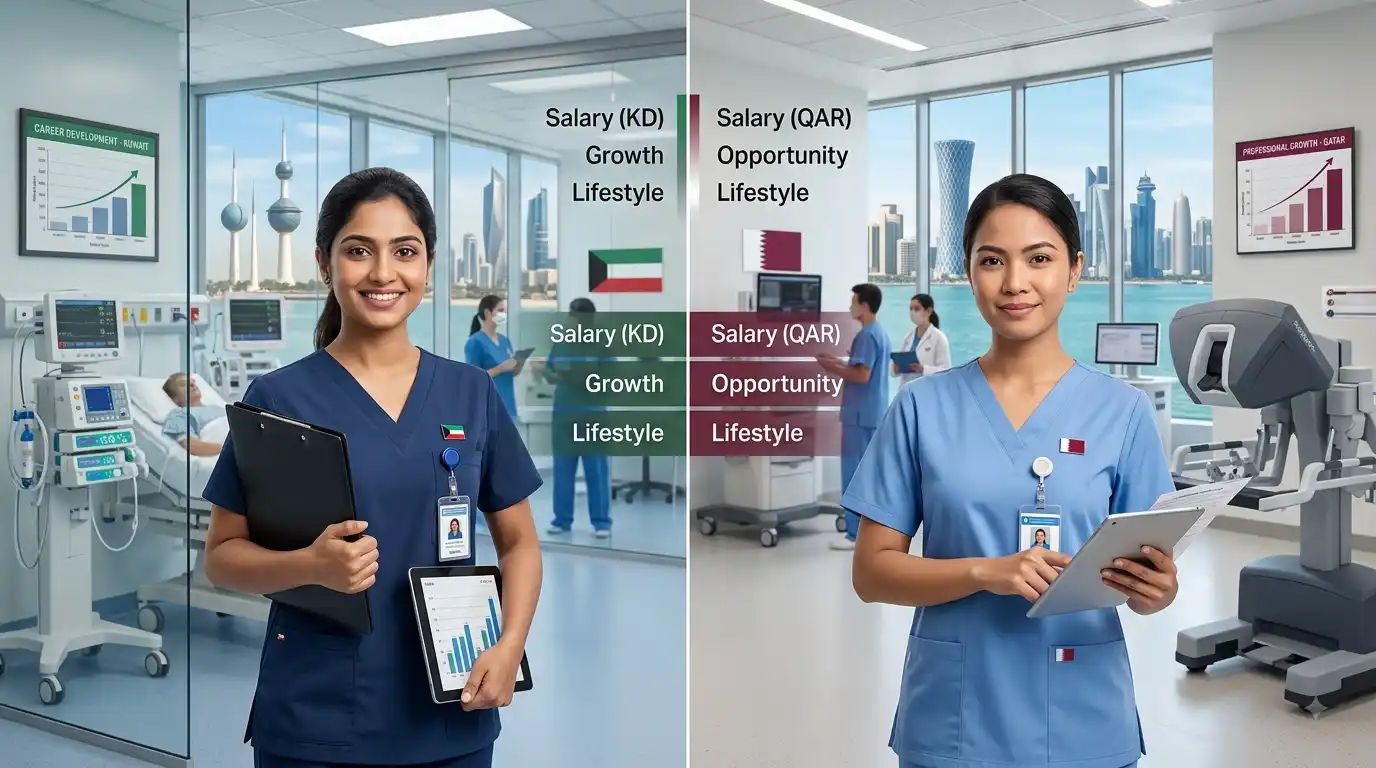
Kuwait nurse vs Qatar nurse For nurses planning an international career, the GCC remains one of the most attractive regions for professional opportunities, competitive salaries, and exposure to modern healthcare systems. Among popular destinations, Kuwait and Qatar are often compared by nurses seeking stable employment and better career prospects. However, choosing between Kuwait and Qatar is not just about salary. The right choice depends on several factors, including career opportunities, requirements, and lifestyle. At Concise International, the best nursing job agency in Kerala, we help nurses explore overseas career opportunities. In this blog, let’s compare Kuwait and Qatar to see which country offers better opportunities for nurses. Kuwait nurse Kuwait has a well-established healthcare sector with opportunities for nurses in government hospitals, private hospitals, clinics, and other healthcare facilities. Nurses can find opportunities depending on their qualifications, experience, licensing status, and the requirements of individual employers. For nurses applying through Kuwait’s Ministry of Health, the requirements may include a recognised nursing qualification, a valid nursing licence, relevant experience certificates, BLS certification, and other supporting documents. Depending on the recruitment pathway, candidates may also need to meet specific requirements related to age, medical fitness, examinations, and interviews. Kuwait can be a suitable option for nurses with relevant clinical experience who are looking for opportunities within an established healthcare system. What Can Nurses Expect in Kuwait? A Kuwait nursing job may offer: Employment opportunities in hospitals, clinics, and other healthcare facilities Opportunities for nurses with relevant qualifications and experience Competitive salary packages depending on the employer and experience Benefits such as accommodation, transportation, medical coverage, and annual leave, depending on the contract Experience working in a multicultural healthcare environment Opportunities to gain experience in different specialities Salary can vary considerably by employer, qualification, speciality, and experience. Current salary data shows a wide range for nurses in Kuwait, so candidates should evaluate the complete employment package rather than salary alone. Qatar nurse Qatar has a modern and well-developed healthcare system and is another major destination for nurses seeking opportunities in the GCC. Nurses can find opportunities across hospitals, clinics, specialist healthcare centres, and other medical institutions. For nurses seeking to work in Qatar, the Department of Healthcare Professions (DHP) under the Ministry of Public Health sets the registration and licensing requirements. For Registered General Nurses with a bachelor’s degree or diploma, the DHP nursing guidelines generally require two years of clinical experience after registration and licensing, while associate-degree holders generally require three years. However, specific requirements and exemptions may vary depending on the applicant’s category and qualifications. Qatar also has a qualifying examination requirement for healthcare professionals, including nurses. However, certain categories are exempt from the examination, including Qatari nationals, children of Qatari women, and graduates of public or private universities and higher-education institutions in Qatar. Nurses should check the latest DHP requirements to confirm whether an exemption applies to them. What Can Nurses Expect in Qatar? A nursing career in Qatar can offer: Employment opportunities in modern healthcare facilities Experience working with multicultural healthcare teams Opportunities in general nursing and specialised areas Competitive salary and benefits packages depending on the employer Professional development opportunities Benefits such as accommodation, transportation, insurance, and travel allowances, depending on the employment contract Potential accommodation, transportation, insurance, and travel benefits depending on the employment contract Salary varies by qualification, experience, speciality, and employer. Current salary data reports an average monthly salary of around QAR 6,937 for registered nurses in Qatar. However, actual offers can be lower or higher depending on the position, experience, employer, and benefits included in the contract. Difference: Kuwait nurse vs Qatar nurse The better choice between Kuwait and Qatar depends on your qualifications, experience, career goals, and preferences. Let’s look at the key differences between the two destinations. 1. Experience Requirements Experience is an important factor when comparing nursing opportunities in Kuwait and Qatar. The requirements can vary depending on your qualification and the licensing pathway. For Kuwait, experience requirements may vary depending on the recruitment and licensing pathway. Nurses should check the specific requirements for the position they are applying for before proceeding. In Qatar, the DHP guidelines generally require two years of clinical experience after registration and licensing for bachelor’s and diploma-level Registered General Nurses, while associate-degree holders generally require three years. However, certain applicant categories may be subject to different requirements or exemptions under current regulations. Nurses should therefore check the specific experience requirements that apply to their qualifications and applicant category before applying. 2. Salary Salary is naturally an important consideration when choosing between Kuwait and Qatar. However, comparing only the basic salary can give a misleading picture. Current salary data reports an average monthly salary of around KWD 486 for nurses in Kuwait and around QAR 6,937 for registered nurses in Qatar. However, these figures come from different salary datasets and should be treated only as general estimates rather than a direct comparison. Actual offers can vary depending on qualification, experience, speciality, employer, and the benefits included in the contract. Nurses should therefore compare: Basic salary Housing or accommodation Transportation Medical insurance Annual air ticket Overtime payment Paid leave End-of-service benefits Working hours and shift patterns A slightly lower basic salary can sometimes provide better overall value if accommodation, transport, insurance, and other benefits are included. 3. Lifestyle and Culture Both Kuwait and Qatar have strong cultural traditions, and nurses moving to either country may experience differences in climate, food, social customs, working practices, and everyday life. Kuwait has a large expatriate community, including a well-established Indian community, making it easier for many Indian nurses to find familiar food, shops, and cultural connections. Qatar, particularly Doha, has a highly international population and offers modern infrastructure, diverse communities, and a wide range of lifestyle and recreational options. In both countries, nurses should be prepared for hot summers, cultural differences, and professional environments where respecting local laws and customs is important. 4. Licensing and Requirements Licensing is another important factor when comparing nursing opportunities in Kuwait and Qatar. In

Saudi Arabia Nurse vs UAE Nurse

Saudi Arabia Nurse vs UAE Nurse Choosing the right destination for a nursing career abroad is an important decision for healthcare professionals. Among the leading destinations for international nursing careers in the Gulf region, Saudi Arabia and the UAE offer attractive career opportunities for qualified nurses, along with competitive benefits, career growth, and international exposure. However, the requirements, work environment, licensing procedures, and lifestyle can differ between these two countries. For nurses from India, especially Kerala, choosing the right career path requires proper guidance from a reliable recruitment partner. As a trusted nursing job agency in Kerala, Concise International helps healthcare professionals explore global opportunities by providing expert guidance, recruitment support, and assistance throughout the overseas placement process. In this blog, Concise International breaks down the key differences between a Saudi Arabia nurse and a UAE nurse to help healthcare professionals better understand the opportunities, requirements, and factors to consider before choosing their preferred destination. Understanding the differences between a Saudi Arabia nurse and a UAE nurse can help healthcare professionals make a more informed career decision based on their qualifications, experience, career goals, and personal preferences. Saudi Arabia Nurse Saudi Arabia is one of the largest healthcare markets in the Middle East and continues to have a strong demand for qualified nurses. The country has a well-developed healthcare system with government hospitals, private healthcare facilities, and specialised medical centres offering opportunities for qualified nursing professionals. Nurses planning to work in Saudi Arabia are generally required to meet the professional standards set by the Saudi Commission for Health Specialities (SCFHS). Depending on the applicable licensing requirements, nurses may need to obtain the necessary professional classification and registration before practising in the country. Saudi Arabia offers opportunities for nurses in various specialities, including: General Nursing Intensive Care Unit (ICU) Nursing Emergency Nursing Operating Theatre Nursing Pediatric Nursing Oncology Nursing Critical Care Nursing Many international nurses choose Saudi Arabia because of its tax-free income, employer-provided benefits that may include accommodation and healthcare coverage, and opportunities to gain experience in a multicultural healthcare environment. The working environment in Saudi Arabia is influenced by the country’s healthcare regulations, professional standards, and cultural values. Nurses are expected to maintain professional ethics, follow hospital policies, and respect local customs while providing patient care. UAE Nurse The UAE is one of the leading destinations for international nurses due to its advanced healthcare facilities, modern infrastructure, and diverse working environment. Cities such as Dubai and Abu Dhabi are home to internationally recognised hospitals, clinics, and healthcare centres that attract nurses from around the world. Nurses planning to work in the UAE must obtain a professional licence from the relevant healthcare authority based on the emirate in which they intend to work. The major regulatory authorities include: Dubai Health Authority (DHA) – Dubai Department of Health – Abu Dhabi (DOH) Ministry of Health and Prevention (MOHAP) – Northern Emirates UAE hospitals provide opportunities in multiple nursing specialities, including critical care, emergency care, medical-surgical nursing, maternity care, and other specialised departments. A UAE nurse can benefit from exposure to international healthcare practices, advanced medical technology, and a multicultural workplace. The country also offers a modern lifestyle with excellent infrastructure, transportation networks, and diverse cultural experiences. Difference: Saudi Arabia Nurse vs UAE Nurse Although both Saudi Arabia and the UAE offer promising career opportunities for nurses, there are differences in experience requirements, salary structures, lifestyle, and licensing procedures. Experience Exemptions Saudi Arabia Nurse: The experience requirements for nurses in Saudi Arabia depend on factors such as qualification, professional category, and regulatory guidelines. Generally, registered nurses are expected to have relevant clinical experience after completing their nursing qualification. Certain categories or candidates may have different eligibility conditions based on their education, registration status, and the requirements of healthcare employers. UAE Nurse: For UAE nursing jobs, experience requirements vary by licensing authority, professional category, and healthcare facility. Registered nurses usually require clinical experience after obtaining their qualification. However, some eligibility pathways may differ based on the applicant’s education, speciality, and licensing regulations. Both countries evaluate nursing qualifications and relevant professional experience as part of the eligibility and licensing process, subject to the requirements of the respective regulatory authorities. Salary Saudi Arabia Nurse: Nursing salaries in Saudi Arabia depend on factors such as qualification, years of experience, nursing speciality, and employer. Many nursing positions include additional benefits such as accommodation, transportation allowances, medical insurance, and annual leave benefits. Saudi Arabia currently does not impose personal income tax on employment income, which may provide nurses with greater savings potential. UAE Nurse: Nursing salaries in the UAE vary depending on the emirate, healthcare facility, specialisation, and professional experience. Nurses working in private hospitals, government healthcare facilities, and specialised centres may receive different salary packages. Benefits may include health insurance, accommodation allowances, transportation support, and other employment benefits. The final salary package in both countries depends on the nurse’s profile and the employer’s offer. Lifestyle and Culture Saudi Arabia Nurse: Saudi Arabia follows Islamic cultural traditions, and nurses working there should be familiar with local customs, social practices, and workplace expectations. The country offers a lower-cost lifestyle in many areas compared to some major global cities, and many expatriate nurses value the opportunity to save money while gaining international experience. UAE Nurse: The UAE offers a highly international lifestyle, especially in cities like Dubai and Abu Dhabi. Nurses can experience a multicultural environment with people from different nationalities. The country provides modern facilities, entertainment options, shopping centres, and excellent connectivity. The cost of living can be higher compared to some locations in Saudi Arabia, especially in major cities. Licensing and Requirements Saudi Arabia Nurse: To work as a nurse in Saudi Arabia, professionals are generally required to complete the licensing process through the Saudi Commission for Health Specialities (SCFHS), subject to the applicable regulatory requirements. The process generally involves verification of educational documents, professional registration, eligibility assessment, and meeting the applicable regulatory requirements. Common requirements may include: Recognised nursing qualification Valid nursing registration from the home

Mental Health Tips for Nurses

Essential Mental Health Tips for Nurses in the Workplace Nursing is one of the most rewarding professions, but it also comes with long shifts, emotional challenges, and high levels of responsibility. Caring for patients every day requires compassion, resilience, and the ability to perform under pressure. While nurses dedicate themselves to improving the health of others, prioritising their own mental well-being is equally important for maintaining both personal health and professional performance. In this blog, Concise International, a trusted nursing recruitment agency in Kerala, shares essential mental health tips for nurses, explains why they matter, and offers practical strategies to help healthcare professionals manage workplace stress, prevent burnout, and build a healthier, more sustainable nursing career. Mental Health Tips for Nurses in the Workplace Self-Care is a Must, Not a Luxury Nurses often place their patients’ needs above their own, but consistently neglecting personal well-being can lead to physical exhaustion, emotional fatigue, and burnout. Self-care is not selfish—it’s essential for providing safe and compassionate patient care. Simple self-care practices can make a significant difference, including: Getting enough quality sleep between shifts Eating balanced, nutritious meals Staying hydrated throughout the day Engaging in regular physical activity Practising mindfulness, meditation, or deep breathing exercises Taking scheduled breaks whenever possible Prioritising self-care helps improve focus, emotional resilience, and overall job satisfaction while reducing stress levels. Setting Healthy Boundaries is Essential Many nurses feel obligated to accept extra shifts, work overtime, or constantly put others before themselves. While dedication is admirable, consistently overextending yourself can negatively affect both your mental and physical health. Healthy workplace boundaries include: Learning to say “no” when additional responsibilities become overwhelming Protecting your scheduled rest days Avoiding excessive overtime whenever possible Maintaining a healthy balance between work and personal life Disconnecting from work-related stress during personal time Establishing clear boundaries allows nurses to recharge, remain productive, and continue delivering high-quality patient care without sacrificing their well-being. Communicate Openly and Seek Support Healthcare environments can be emotionally demanding, and trying to manage stress alone often makes challenges more difficult. Open communication creates opportunities for support, problem-solving, and improved workplace relationships. Consider: Speaking with supervisors if your workload becomes unmanageable Sharing concerns with trusted colleagues Participating in team discussions and debriefing sessions Seeking professional counselling or employee assistance programmes when needed Asking for help without feeling guilty Strong communication helps reduce workplace stress and fosters a supportive culture where nurses feel valued and understood. Never Stop Learning Continuous learning not only improves clinical skills but also builds confidence in handling complex patient situations. Feeling well-prepared often reduces workplace anxiety and increases professional satisfaction. Professional development may include: Attending nursing workshops and seminars Completing certification programmes Participating in continuing education courses Staying updated with evidence-based healthcare practices Learning new technologies and clinical procedures Investing in your knowledge strengthens both your career prospects and your confidence in delivering quality patient care. Build a Strong Professional Network Having a reliable support network can significantly improve mental well-being throughout your nursing career. Connecting with fellow healthcare professionals provides encouragement, shared experiences, and valuable career guidance. Ways to build your professional network include: Joining nursing associations and professional organisations Attending healthcare conferences and industry events Participating in online nursing communities Building positive relationships with colleagues and mentors Staying connected with former classmates and healthcare professionals A strong network not only provides emotional support but also opens doors to career opportunities, professional growth, and valuable learning experiences. Conclusion Maintaining good mental health is essential for every nurse, both personally and professionally. By prioritising self-care, setting healthy boundaries, communicating openly, continuing to learn, and building a supportive professional network, nurses can better manage workplace stress while delivering high-quality patient care. If you’re planning to advance your nursing career or explore opportunities abroad, partnering with a trusted nursing recruitment agency like Concise International can provide the guidance and support you need at every stage of your professional journey.

Oman Nurse vs Bahrain Nurse

Oman Nurse Vs Bahrain Nurse GCC countries have become a preferred destination for nursing professionals seeking better career opportunities, professional growth, and an improved quality of life. Among the various options, Oman and Bahrain continue to attract many Indian nurses due to their expanding healthcare sectors and promising career prospects. If you’re planning to work in either of these countries, understanding the key differences between them is essential. From licensing requirements and experience exemptions to salary packages, each destination offers unique advantages. In this blog, Concise International, a leading nursing job agency in Kerala, breaks down the key differences between nursing careers in Oman and Bahrain to help you choose the destination that best aligns with your career goals. Oman Nurse The Sultanate of Oman, commonly known as Oman, is recognised for its well-developed healthcare system and growing demand for qualified nursing professionals. With opportunities across government hospitals, private healthcare institutions, and speciality clinics, the country continues to attract nurses seeking rewarding international careers.​ To work as a registered nurse in Oman, candidates must obtain professional licensure from the Oman Ministry of Health (MOH). In addition to meeting the required educational qualifications, applicants are also expected to complete the necessary documentation and licensing procedures before beginning employment.​ Some of the key benefits of working as a nurse in Oman include:​ Competitive tax-free salary packages Good work-life balance Modern healthcare facilities Opportunities in government and private hospitals Employer-provided benefits such as accommodation, transportation, medical insurance, and annual leave (depending on the employer) Whether you’re seeking career growth, international exposure, or long-term professional opportunities, Oman offers a promising destination for qualified nursing professionals. Bahrain Nurse Bahrain is another attractive destination for nurses seeking international career growth. The country offers excellent healthcare infrastructure, advanced hospitals, and opportunities to work alongside healthcare professionals from around the world.​ Benefits of working as a nurse in Bahrain often include:​ Tax-free income Exposure to internationally accredited healthcare facilities Career advancement opportunities Multicultural working environment Attractive employee benefits offered by many employers Bahrain is an attractive destination for nurses seeking opportunities in a smaller GCC country with a modern healthcare system and tax-free income. Difference: Oman Nurse vs Bahrain Nurse Although both countries offer excellent opportunities, there are several important differences that every nurse should understand before deciding where to work. Licensing Exam ​ One of the biggest differences between starting a nursing career in these two countries lies in the licensing process. ​ Oman: To work as a registered nurse in Oman, candidates are generally required to pass the licensing examination as part of the registration process. They must also complete the necessary credential verification and documentation procedures before becoming eligible for employment in the country’s healthcare sector ​ Bahrain: ​To work as a registered nurse in Bahrain, eligible candidates must complete the NHRA (National Health Regulatory Authority) licensing process. This typically includes credential verification and the required licensing examination before professional registration is obtained. While both countries require licensing, the regulatory authorities and documentation procedures are different. ​ Experience Exemptions ​Experience requirements can significantly influence a nurse’s choice between Oman and Bahrain. Oman: Depending on the latest regulations and employer requirements, certain nurses may qualify for an exemption from the minimum experience requirement, subject to the applicable eligibility criteria. Bahrain: ​Bahrain generally places greater emphasis on prior clinical experience before licensing and employment. Experience requirements may vary depending on the healthcare employer, nursing speciality, and current NHRA regulations. Since licensing requirements may change over time, nurses should always verify the latest eligibility criteria before beginning the application process.​ Salary Salary is another important factor when comparing Oman and Bahrain. Oman: Nurses working in Oman generally receive competitive tax-free salaries along with employer-provided benefits such as accommodation, transportation, annual air tickets, medical insurance, and paid leave, depending on the terms of their employment contract. Bahrain: Nurses in Bahrain generally receive tax-free salaries, with compensation varying based on experience, speciality, hospital, and employer type. Many employers additionally provide or subsidise accommodation, transportation, insurance, and annual vacation benefits. While salary packages differ from one employer to another, both countries offer attractive earning and savings potential compared to many domestic opportunities. Conclusion Both Oman and Bahrain offer rewarding career opportunities for nursing professionals, each with its own advantages. Choosing between the two involves more than just comparing salaries. Factors such as licensing procedures, experience requirements, career growth opportunities, and employer benefits all play an important role in making the right decision. If you dream of building a nursing career in the GCC, partnering with an experienced nursing job agency in Kerala can simplify every stage of your overseas journey. At Concise International, we are committed to connecting nursing professionals with rewarding opportunities across the GCC. With professional guidance and dedicated support throughout the recruitment process, we help nurses take confident steps toward successful international careers. Connect with Concise International today and turn your GCC nursing career aspirations into reality.

How to apply for a nursing job in Oman

How to Apply for a Nursing Job in Oman: The Ultimate 2026 Guide for International Nurses Dreaming of building your nursing career in the Sultanate of Oman? With its tax-free salary, modern healthcare infrastructure, and growing demand for skilled healthcare professionals, Oman continues to attract thousands of qualified nurses from around the world. However, working as an international nurse in Oman requires more than securing a job offer. You must meet the eligibility criteria set by the Ministry of Health (MoH) and complete a structured licensing and verification process. This guide covers everything you need to know to successfully apply for a nursing job in Oman. Eligibility Check: How to Apply for a Nursing Job in Oman? Applying for a nursing job in Oman starts with confirming your eligibility and preparing the required documents, including your educational certificates, nursing registration, experience certificates, and passport. You will then complete the required credential verification and licensing requirements, which may take place before or alongside the recruitment process, depending on the employer or recruitment pathway. Once selected by an approved healthcare employer or licensed recruitment agency, your employer will complete the remaining licensing, work visa, and relocation formalities, allowing you to begin your nursing career in Oman.  Before starting your application, make sure you meet the latest eligibility requirements. BSc Nursing graduates generally require a minimum of 3 years of continuous post-registration bedside experience.  General Nursing and Midwifery (GNM)/Diploma nurses generally require a minimum of 4 years of continuous clinical experience.  Your clinical experience must be post-qualification and supported by valid employment records. You should not have a clinical gap exceeding 6 months between your recent nursing roles, as prolonged gaps may affect eligibility depending on the licensing assessment and employer requirements. Document Blueprint: What You Need Before Knowing How to Apply for a Nursing Job in Oman Before starting the licensing process, ensure all required documents are complete and up to date Core Document Requirement Specific 2026 Compliance Standard Academic Credentials Degree/Diploma certificate + comprehensive semester mark sheets/transcripts. Professional Registration Valid, active nursing registration/license from your home country’s Nursing Council. Good Standing Certificate (GSC) Issued within the last 6 months by your local nursing council. Experience Verification Official experience certificates that match your employment history and CV, with no unexplained employment gaps. Legal Clearances Valid passport (minimum 1-year validity) + valid Police Clearance Certificate (PCC) Partnering with a Certified Nurse Recruitment Agency to Fast-Track Your Application Applying independently can be challenging because the process involves credential verification, licensing requirements, hospital sponsorship, embassy procedures, and visa documentation. Even small documentation errors can delay approvals. Working with an experienced recruitment agency like Concise International simplifies the journey. From credential verification and job placement to visa lodgement and employer coordination, the agency provides end-to-end recruitment solutions, helping qualified nurses connect with leading hospitals across Oman while reducing documentation errors and processing delays. Step-by-Step Guide: How to Apply for a Nursing Job in Oman Successfully Primary Source Verification via DataFlow: Submit your educational and professional certificates to DataFlow Oman. They independently cross-verify your background directly with your university and past employers. Acquire Your MoH Eligibility ID: Once your DataFlow Primary Source Verification (PSV) is completed, register on the Oman Ministry of Health portal to obtain your unique eligibility tracking number. This number is used to track your licensing application throughout the process.  Clear the Oman Prometric Exam (CBT): Book and complete the Oman Prometric examination at an authorized test centre. Candidates must achieve the required passing score to become eligible for the next stage of the nursing licensing process.  Certificate Attestation & Legalization: Get your required documents attested through the appropriate government authorities, including the HRD/Home Department (as applicable), the Ministry of External Affairs (MEA), and the Oman Embassy. This attestation confirms the authenticity of your documents for official use in Oman.   Hospital Interview & MoH License Issuance: Attend the placement interviews arranged by your recruitment agency. Once selected, your employer or hospital sponsor will complete the final Oman Ministry of Health (MoH) licensing formalities and initiate your work visa process. Demystifying the Exam: How to Apply for a Nursing Job in Oman and Pass the OMSB Prometric Test The Oman nursing licensing examination is a computer-based test conducted at authorized Prometric centres for the relevant licensing authority. It generally lasts 2.5 hours and consists of approximately 70–100 MCQs in English. Candidates must meet the passing threshold prescribed by the relevant licensing authority to proceed with the licensing process. The OEN syllabus focuses on: Fundamentals of Nursing Medical-Surgical Nursing Pediatrics Obstetrics & Gynecology Pharmacology Community Health Nursing Understanding the exam blueprint, practising the MCQ format, and completing your test-centre booking early will improve your chances of success. Common Mistakes to Avoid When Figuring Out How to Apply for a Nursing Job in Oman Many applications are delayed because of avoidable mistakes, including: Attempting remote or home-based examinations instead of attending an authorized in-person testing centre. Uploading blurred, cropped, or low-resolution academic documents during DataFlow verification. Submitting documents with spelling differences between your passport, nursing registration, educational certificates, and other official documents.  Review every document carefully before submission to prevent unnecessary delays. Timeline & Costs: What to Expect When You Learn How to Apply for a Nursing Job in Oman While timelines vary, DataFlow verification generally takes 4–8 weeks, depending on document verification and institutional responses. From collecting documents to joining your employer in Oman, the complete process typically takes 4–6 months. Applicants should also budget for verification fees, examination charges, certificate attestation, embassy charges, visa processing, and other regulatory documentation expenses. Planning helps ensure a smoother processing window and mobilization time for Muscat healthcare jobs and other opportunities across Oman. Conclusion: Take the Next Step in Knowing How to Apply for a Nursing Job in Oman Learning how to apply for a nursing job in Oman may seem overwhelming at first, but with the right preparation and expert guidance, the process becomes much more manageable. By meeting the eligibility requirements and completing each step correctly,

© Copyright. All rights reserved
Powered By: tlmstudios.in