
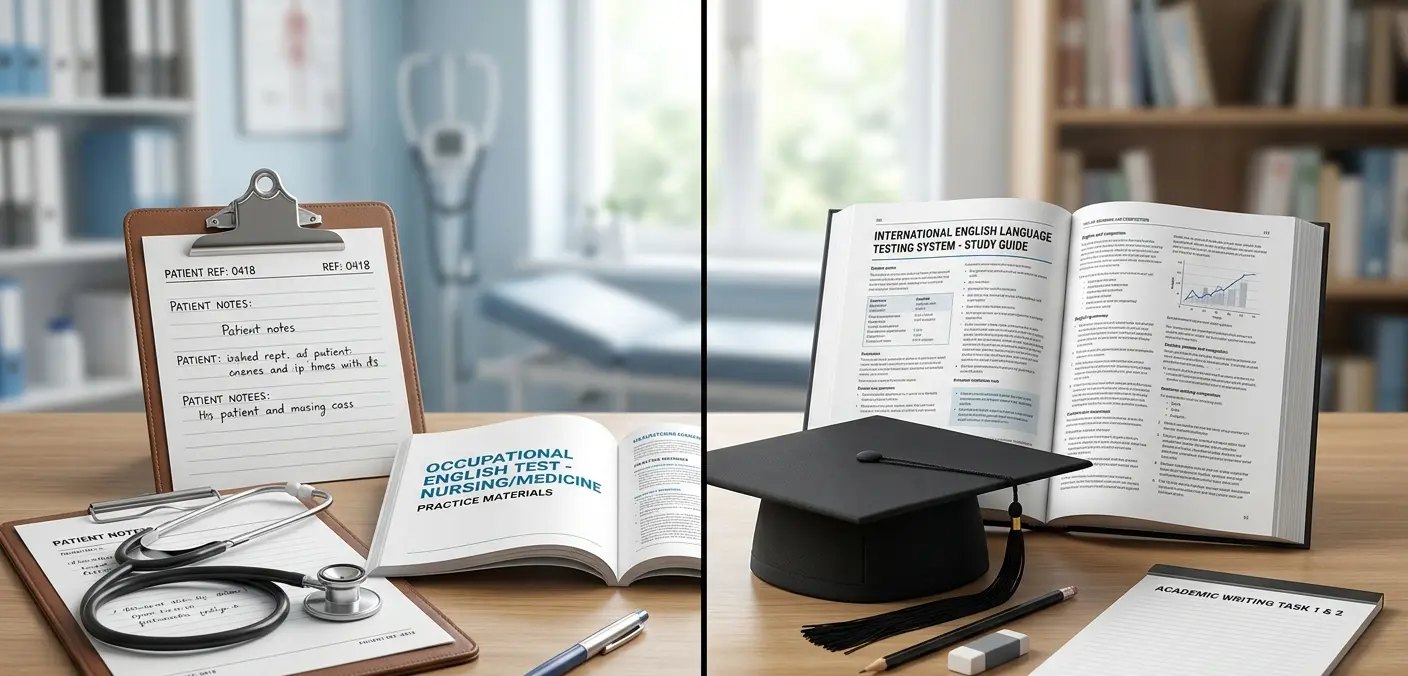
OET vs. IELTS: Why 80% of Healthcare Professionals are Switching from IELTS in 2026
For years, IELTS was considered the gold standard for demonstrating English competence among aspiring healthcare professionals. However, by 2026, the trend has changed, with an increasing number of nurses choosing the Occupational English Test (OET) as their preferred route. The reason is simple: OET is tailored exclusively to the healthcare industry, making it more relevant, practical, and in line with real-world medical communications. Candidates can focus on the situations they face in their everyday work lives rather than studying generic subjects, making the process simpler and more efficient.
As worldwide demand for skilled nurses continues to rise, selecting the correct exam has a major effect on how fast you achieve your international career goals. In addition to increasing your chances of success, OET gets you ready for actual clinical settings overseas. With the correct guidance from the best nursing job agency in Kerala, you can improve your preparation, conquer the exam faster, and comfortably step into global opportunities.
The Core Difference: General English vs. Healthcare Context
The most significant difference between IELTS and OET is what you are really tested on. IELTS assesses your proficiency in a variety of everyday contexts. You might be requested to write or speak about topics like the history of space travel, environmental problems, or global trends, subjects that have little to do with your day-to-day work as a healthcare provider.
OET, on the other hand, is based solely on the medical field. You will be evaluated on real-world situations, such as describing a discharge statement, writing a referral letter, or discussing a patient’s health and treatment plan with a patient’s relative, rather than abstract subjects. These are tasks you are already familiar with, so the exam will feel more realistic and relevant.
This healthcare-focused approach not only makes preparation easier but also helps you develop communication skills that are immediately applicable to your career as a nurse or medical professional abroad.
Why 2026 is the Year of the OET Switch
The shift toward OET is more than just a trend; it is motivated by real, practical benefits that are important to healthcare professionals seeking to work abroad.
- Higher Pass Rates: One of the primary reasons for the switch is the success rate. Nurses are significantly more likely to acquire a Grade B in OET on their first attempt than to obtain a Band 7 in IELTS. Since OET focuses on common medical terminology and real-world clinical settings, applicants frequently find it easier to understand, prepare for, and perform well, avoiding the need for multiple attempts.
- Relevance to Practice: OET preparation improves your abilities as a healthcare worker in addition to helping you pass the test. From writing discharge summaries and referral letters to efficiently interacting with patients and their families, all facets of OET training mirror real hospital situations. This means you’re not just preparing to take a test; you’re preparing to function confidently and competently in a foreign healthcare setting.
Partnering with the Best Nursing Recruitment Agency in Kerala to GCC
Choosing the correct exam is only one part of your journey; having proper guidance can make all the difference when considering your move to GCC countries. Partnering with the best nursing recruitment agency in Kerala to GCC assures that you are not going through this process alone. From personalised OET instruction and exam techniques to documentation help and placement assistance, a reputable firm streamlines the process.
These agencies recognise the particular needs of GCC healthcare systems, assisting you in matching your qualifications, language scores, and professional skills with job demands. They also offer insights on licensing procedures, interview preparation, and cultural adaptability, allowing you to transfer more smoothly into your new role.
With experienced assistance from the best nursing recruitment agency in Kerala to GCC, you may accelerate your international career, avoid typical mistakes, and confidently pursue exciting nursing positions throughout the Gulf area.
OET for Nurses: Why 80% of Healthcare Professionals are Switching from IELTS in 2026
- Content: One key reason for the change to OET is how well the exam fits into a nurse’s professional mentality. Everything about the experience, from study to test day, seems familiar, pertinent, and motivated. Instead of entering an academic examination setting, you will be immersed in circumstances that match your daily clinical responsibilities.
- Writing: IELTS writing tasks frequently revolve around broad topics such as technology, education, and global challenges. This necessitates learning essay forms and arguments that might not be relevant to your line of work.
With OET, the writing work is closely related to nursing practice. Drafting referral letters, discharge summaries, or transfer notes based on case information will be your task. These are documents you already work with in real life, making the task more practical, easier to prepare for, and extremely relevant to your future role abroad.
- Speaking: The IELTS speaking test is administered as a structured interview in which you share personal viewpoints or abstract concepts. Although it evaluates fluency, it is not representative of an actual healthcare conversation.
OET replaces this with roleplay. You’ll communicate with an examiner as a patient or carer, explaining conditions, giving instructions, or offering reassurance. This arrangement enables you to exhibit not only language skills but also clarity and empathy, which are essential traits in the nursing profession.
- Listening: IELTS listening consists of both everyday conversations and academic lectures, such as university discussions or presentations. These may seem disconnected from the day-to-day experiences of healthcare professionals.
On the other hand, OET listening has its roots in therapeutic settings. You will observe patient consultations, understand symptoms, and interpret talks among healthcare experts. This aligns the test more closely with real-world hospital settings and increases your ability to listen effectively in critical situations.
Cost vs. Reward: Is OET Worth the Investment?
At first glance, OET may appear to be more expensive than IELTS, a valid issue for many aspiring nurses. Looking past the initial cost, however, shows a more useful truth: OET frequently offers greater value over time.
The “one-and-done” success rate is crucial. Many nurses are able to obtain the necessary Grade B on their first try since OET is designed with healthcare workers in mind. In contrast, IELTS frequently necessitates several retakes in order to get a Band 7, which raises overall expenditures because it is less relevant to clinical work and more broad.
Each IELTS retake doesn’t just mean another exam fee. Additionally, it causes months of delays that could have been used to work overseas and earn more money. When you consider these missed possibilities, the initial greater cost of OET appears to be a strategic investment rather than an expense.
Checklist for Nurses
Before you start your journey abroad, make sure you have the following important paperwork ready:
- Valid Passport: When travelling abroad, your passport serves as your primary form of identity. For the purpose of applying for visas and travelling overseas, it must be updated and valid for a minimum of six months.
- Degree/Diploma Certificates: These records attest to your nursing education. They are required to register for exams, verify credentials, and apply for jobs in foreign healthcare systems.
- Registration Council Certificate: This certificate, issued by your state or national nursing council, confirms that you are a licensed and registered nurse who can practise in India and abroad.
Having these in place will make it easier for you to proceed with the hiring, licensing, and testing procedures. Ready to start your global nursing career? Get professional advice and comprehensive help from Concise International right now to move forward confidently.
Conclusion
Choosing between OET and IELTS can impact how soon and confidently you begin your foreign nursing career. While IELTS remains a general benchmark, OET stands out for healthcare workers because of its practical approach, higher first-attempt success rates, and direct connection to real-world clinical communication. Preparing for the realities of working in a global healthcare system is more important than simply passing a test.
If your goal is to move faster, minimise repeated attempts, and develop skills that truly matter on the job, OET is the smarter choice in 2026. With the help of the best nursing recruitment agency in Kerala to GCC, such as Concise International, you can streamline everything from test preparation to placement, transforming your abroad goal into a well-planned and attainable career path.